avatar

By User10959

August 21, 2026, 11:46 am

Improper resulting outputs on a 1045 steel case

Hello,

Using trial version, so far have had good results and enjoy the GUI!

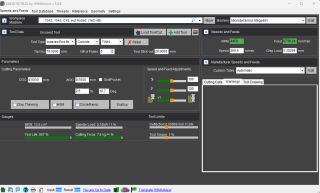
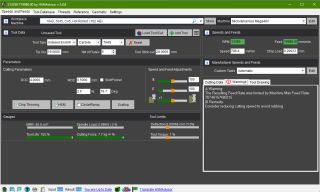
The following screenshot shows outcomes I received that were excessive on feed rate and surface speed.

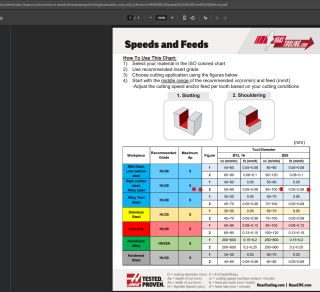
For reference included is the HAAS chart for this HMEIM tool, a compact 5 flute 3/4" index mill.

Observations:

1. At 140m/min this tool performs correctly, good surface finish and blue chips

2. At their (HAAS) recommended 90 m/min there is BUE and poor outcomes. Their chip load is also 4x lower than HSM's recommendation (partially because this is a compact 5 flute).

3. I can imagine that with blue chips at 140, attempting HSM's recommendations (attached) would be over speed, 4400 to 13k RPM defies my normal logic in this regime.

Please let me know what is going on with this, thanks.
Screenshot 2026-08-21 073846.png Screenshot 2026-08-21 073846.png HSM off Screenshot 2026-08-21 074259.png HSM on Screenshot 2026-08-21 073222.png
Please register and/or log in to leave comments!
avatar

Eldar Gerfanov (Admin)

September 7, 2026, 8:40 pm

Hello,

Since its actually 2 questions i will split my research into two asnwers:

The high feed rate occurs because of very small material engagement of just 0.5mm WOC - the calculator intentionally increases the feed rate to maximize productivity in that scenario. 

The HSMAdvisor is not designed to produce finishing speeds and feeds when F override is at 100%; its default mode is medium roughing. So when it detects small engagement, it bumps the feed rate accordingly based on material hardness - this is how the load balancing mechanism is designed to work.

Chip Thinning, can be applied after and will additionally increase the feed rate depending on the cutter geometry and the engagement factors. So you would get not one but two feed rate bumps.

Please let me know if this answers your concerns regarding the feed rate.

avatar

Eldar Gerfanov (Admin)

September 7, 2026, 8:57 pm
Updated by: Eldar Gerfanov (Admin)

Hello,

Here is my research into the high cutting speed in your example.

Given Haas’s recommendation of just 90 m/min for the base cutting speed, HSMAdvisor’s resulting 798 m/min does indeed look excessive at first glance.

HSMAdvisor arrives at that number by multiplying the base cutting speed for an average indexed end mill, 266 m/min, by an HSM factor of 3×.

That said, the individual factors used by HSMAdvisor are not out of line with recommendations from other tooling manufacturers. For comparable indexable shoulder milling in 1045/C45-class steels, Kennametal publishes base cutting speeds in roughly the 180–300+ m/min range depending on insert grade and cutter family, so HSMAdvisor’s 266 m/min base recommendation is in the same general range.

The same is true for HSM speed compensation. Increasing cutting speed as radial engagement decreases is standard practice. At your 0.5 mm WOC on a 19 mm cutter, radial engagement is only about 2.6% of diameter.

Kennametal publishes the following cutting-speed multipliers for several carbide milling families:

  • at 5% radial engagement: approximately 1.6× to 2.5×
  • at 4%: approximately 1.6× to 3.0×
  • at 2%: approximately 2.1× to 3.6×

So at approximately 2.5% engagement, HSMAdvisor’s 3× maximum multiplier is within the range published by Kennametal for low-radial-engagement milling.

Kennametal’s HARVI IV data uses a somewhat more conservative stepped table: 2.5× for engagement above 2% and up to 5%, and 3× at 2% or less. That would put this 2.6% engagement case at about 2.5× under that particular tool family.

ISCAR is more conservative again, showing a 1.9× cutting-speed factor at 5% radial engagement, but it uses the same underlying principle: lower engagement allows higher cutting speed due to reduced cutting-edge contact time.

So while the final 798 m/min result is certainly aggressive, neither the 266 m/min base speed nor the low-engagement HSM multiplier is obviously unreasonable when compared individually against published manufacturer data.

What still stands out is the final combined result. In this case, the very low 0.5 mm WOC drives HSMAdvisor all the way to its 3× cap. Even though that multiplier is supported by some manufacturer data at this engagement level, the resulting surface speed is high enough that I would like to review whether indexed cutters should use a different or more conservative HSM limit than solid-carbide tooling.

To be honest, I too would be wary of running it at that speed even at such low radial engagement. But at the same time I have examples of HSM machining that seem to defy  conventional logic.

So for me personally, I would start at the 30% feed and speed override on the machine and then slowly work up the numbers to 100%. If i see sparking then i back off - its obviously too hot. By the way HSM does not expect use of coolant because sudden thermal shock will cause coating cracking and rapid edge degradation.

@ForumAutomation please create a GitHub issue to review the HSM speed multiplier/limit for indexable end mills at very low radial engagement, using this case as an example:

  • Material: 1043 / 1045 / C45, hot rolled
  • Tool: 19 mm, 4-flute carbide TiAlN indexed end mill
  • DOC: 4.0 mm
  • WOC: 0.50 mm
  • Radial engagement: ~2.6%
  • Normal shoulder-milling speed: ~266 m/min
  • HSM-adjusted speed: ~798 m/min
  • HSM multiplier: ~3×
  • Kennametal published HSM factor around this engagement: roughly 2.5× to 3×+, depending on tool family
  • Customer reports good results around 140 m/min

PS; the reponse is entirely mine, but i used ChatGPT to fetch me links, run quick math, and proofread my text. Here is the sources used:
https://www.kennametal.com/us/en/products/p.mill-4-15-shell-mill-inch.5702496.html
https://www.kennametal.com/us/en/products/p.harvi-ii-te-radiused-5-flutes-plain-shank-inch.7157109.html
https://www.kennametal.com/us/en/products/p.7102426.html

avatar

ForumAutomation

September 7, 2026, 9:09 pm

Hello,

GitHub issue has been created to review the HSM speed multiplier/limit for indexable end mills at very low radial engagement, using this case as the example:

swindex/HSMAdvisor#139 — Review HSM speed multiplier/limit for indexable end mills at very low radial engagement

The issue includes the full case details (material, tool, DOC/WOC, engagement, base vs HSM-adjusted speed), the Kennametal/ISCAR reference data cited above, and suggested review items. It will be tracked there going forward.

Thanks for the detailed report — it helped a lot with the analysis.

avatar

User10959

September 7, 2026, 10:03 pm

Thanks for the detailed responses Eldar!  I hear you. If this particular one goes to production I'll push the surface speed and take notes re: the threshold on this tool/material, it's not a very expensive insert set.

For now 140 is a good place for me.  Many of the other calculation results have been quite ideal, drilling, tapping, milling, the fundamental nature of the program seems solid; this was just an outlier.

Also for the Gihub note:  its a 5 flute 19mm index, not 4 flute.

Eric

© 2009-2022 Eldar Gerfanov. All Rights Reserved.
© 2009 Eldar Gerfanov. Materials on this site are presented as is and are mostly for educational use.

You may freely reproduce information presented herein without any consent from me, provided you include link to this site.
In case when i am not the copyright holder, you may want to contact proper owner of material. Anyway, they are freely available on the Internet.
If you hold the copyright right for any of the materials on this site and want them removed, please contact me here